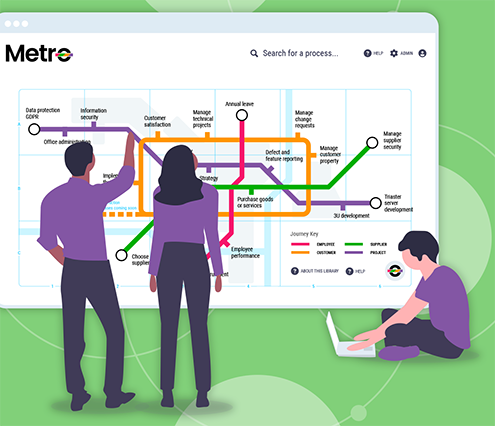
How to use AI Safely in Business Process Management

Giles Green

Artificial Intelligence (AI) is rapidly reshaping how organisations operate. Much of the conversation to date has focused on what AI can do - but far less attention has been paid to what it depends on. 

This article explores how to ensure the quality of the business process information AI draws on and the risks of not doing so, by discussing:

What is AI for Business Process Management?

AI for business process management is the use of artificial intelligence to help employees understand, follow, and execute the correct way of working across an organisation.

At its best, it allows an employee to ask the simple question:
“How do I…?”
…and receive a clear, accurate, step-by-step answer tailored to how their company actually operates.
 
But there is a fundamental problem.
 
AI does not create knowledge. It amplifies it and many organisations are trying to apply AI to unstructured, inconsistent, and unreliable process information. 

AI Is Only as Good as the Processes It Understands

AI does not “know” your business. It predicts answers based on the information it is given.
 
So if your process knowledge is:
  • Stored in scattered documents
  • Written inconsistently
  • Buried in SharePoint folders
  • Dependent on individual interpretation
Then your AI will:
  • Give inconsistent answers
  • Merge different processes together
  • Miss critical steps
  • Create risk instead of reducing it
And it will do so at great speed and with much authority.

The Key Layer: A Structured Process Library

For AI to work reliably in operations, it needs to be able to access information that is accurate, structured, and current. It needs a single source of truth that is:
  • Structured
  • Standardised
  • Governed
  • Context-rich

In other words, it needs an up-to-date Business Process Management system, such as the Triaster Process Library, to draw information from.

How the Triaster Process Library Enables AI

Triaster's Process Library provides AI with something many organisations lack:
 

1. Structured, Standardised Machine-Readable Processes

Triaster processes are captured using the Noun-Verb methodology, meaning each step is:
  • Clear
  • Consistent
  • Unambiguous
  • Standardised
This makes it far easier for AI to interpret compared to free-text documents.
 
Additionally, processes are:
  • Mapped visually
  • Stored as structured data
  • Underpinned by a database
This allows AI to understand:
  • Sequence
  • relationships
  • dependencies
—not just text.


2. Context Beyond the Steps

A process is not just “what to do”.
It includes:
  • RACI (who does what, who owns the process and who else must be involved)
  • Systems used
  • Linked documents (e.g. SharePoint, DMS)
  • Controls and governance rules
All this is captured in a Triaster Process Library, which means that when an employee asks:
“How do I book annual leave?”
AI can return:
  • The correct steps
  • The system to use
  • The responsible role
  • Any supporting documents
All in one clear, simple answer.
 
pl-2-v2
 
3. Governance
 

Governance is how you ensure that the information in your Process Library is accurate and up-to-date and reviewed and signed off by the correct, responsible person.

Governance is how you structure your Process Library and give appropriate access to users.

Governance is key to minimising risk in any organisation.

Governance is a key part of Triaster's implementation and training packages, ensuring that your Process Library is structured to support operational clarity, change control and accuracy.
 
Being able to access such accurate, structured and current information transforms AI into a reliable operational assistant (not just a chatbot).

The Benefits of a Structured Process Library - AI or Otherwise


1. Errors and Rework are Reduced

When every answer found in a Process Library is based on the correct, governed process:
  • Variation drops
  • Mistakes reduce
  • Rework decreases
Instead of guessing or asking colleagues, employees get the right answer, first time.
 

2. Change Management that Actually Sticks

Most change initiatives fail because:
  • People don’t follow the new process
  • Old ways of working persist
With a Process Library:
  • The current approved processes are easily accessible
  • Changes are accurately reflected in process enquiry answers
  • Old practices are more easily replaced
This makes change:
  • Controlled
  • Visible
  • Enforceable

3. Compliance, ISO, and Audit Readiness

A governed Process Library ensures:
  • Processes are followed consistently
  • Responsibilities are clear
  • Evidence is structured and accessible
Therefore, instead of scrambling to get ready for audits, the system already reflects reality. (This aligns directly with ISO and process-based management principles.)
 
pl-4-v2
 

4. Scaling Operations Without Losing Control

As organisations grow:
  • Informal knowledge breaks down
  • Inconsistency increases
  • Control weakens
Structured processes allows you to:
  • Scale knowledge instantly
  • Maintain consistency across teams
  • Support new hires without relying on tribal knowledge
This is how businesses grow most effectively.

 The Risks of AI in Business

Many organisations are rushing to deploy AI on top of:
  • Disconnected documents
  • Inconsistent SOPs
  • Uncontrolled knowledge
This results in:
  • Incorrect answers and information being returned by AI 
  • The weaknesses in how organisations manage knowledge being accelerated and amplified
  • Inconsistent working
  • Errors and poor quality 
  • Increased risk

In an AI-enabled environment, gaps, inconsistencies and outdated processes are no longer minor inefficiencies - they become systemic risks. Without a robust and up-to-date foundation, AI tools have nothing reliable to anchor to.

The Solution: AI That Understands How Your Business Actually Works

When AI can access information in a structured, governed Process Library:
  • It gives accurate answers
  • It guides execution
  • It reinforces consistency
  • It scales knowledge
And, most importantly, it enables every employee to perform correctly, every time.
 Related Articles


How a Process Library Can Solve Business Efficiency Problems

System Change Without Process Clarity: A Guaranteed Failure Point

The Top 10 Benefits of Process Mapping


Written by Giles Green

Giles joined Triaster in 2017 and is now our Business Improvement Director, working with organisations to increase efficiency, break down siloed working and improve their processes. Giles is passionate about solving business problems and how often a Process Library can do just that.